One of the most important techniques to protecting your home is creating layers of security. It’s not very difficult for a burglar to get past one line of defense. The more difficult it is and the longer it takes a burglar to break into your home, the more likely they’ll run away. Neighbors are also more likely to spot someone breaking in if you are able to slow any potential thieves down. Adding additional layers of security can easily mean the difference between staying protected and a potential robbery.
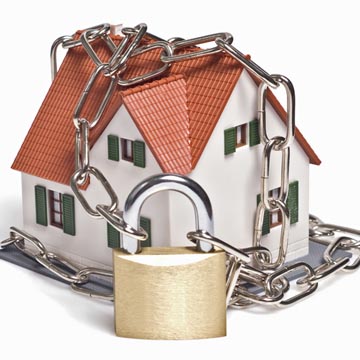
The first line of defense is your exterior. Make sure your exterior is well maintained and looks occupied, even if you’re away. Unmowed lawns, newspapers on the porch, and mail piling up are all signs that no one is watching the house. Motion detector lights and well trimmed bushes/hedges protect you from people sneaking onto your property. If you need to leave a spare key outside, make sure it is well hidden and not in commonly checked places (under the mat, in the mailbox, under an out of place fake rock). For the most effective security, external weatherproofed security cameras with a 24 hour monitoring company can provide a high level of protection.
Your house itself is your next line of defense. About 85% of burglaries take place with the thief entering through the front or back door. About 60% of break ins are accomplished using force. Replace hollow doors with solid-core doors, add a dead-bolt, and reinforce the door jamb with metal. Adding a security film to windows will make them much more difficult to break. Most importantly, make sure all windows and doors are locked when you leave the house, even for a quick trip to the store. 30% of burglaries occur through an unlocked window or door.
Inside your house is the most critical line of defense. Use thick drapes and keep valuables out of view so burglars can’t see inside what you have inside your house. Electronics and jewelry are often the most sought-after items for criminals. Identify theft is also one of the fastest growing crimes. Make sure these valuable assets are protected – a large heavy Internal motion detectors, glassbreak detectors, and video cameras on an alarm system provide a comprehensive defense against potential burglaries.
While the physical barriers to a burglar getting in is extremely important, another aspect to remember is the psychological defenses. Signs and stickers that an alarm system is installed in the house are great deterrents. A dog is also a very large reason many potential burglars would avoid a house – even if you don’t have one, making it look like you do by posting a sign or leaving a leash outside can help. Audible alarm systems are not just to alert you or neighbors to a potential intruder, but also to scare away anyone that has made it into your house.



 When you’re starting any kind of project, what’s one of the first things you do? In all likelihood you go to your computer, smartphone, or mobile device and open up a search engine. You run search after search to find what you’re looking for. In our connected world of the IoT (Internet of Thing) we are, at least partially, reliant on what we can find online. You can find information on virtually anything. This includes anything from how to properly stain a deck to how to choose which security system integrator is the best.
 In the wake of home automation, smart home, or connected home technology you may have come across the term Z-Wave technology. What is it?
  When you think motion detectors (or sensors) you might picture a heist scene from the movies where a thief has to perform acrobatics in order to avoid a web of alarm triggering laser-beams surrounding a priceless gem. While that narrative is not necessarily complete fiction, it’s not exactly how motion detection is implemented in the real world. In modern day applications security system integrators use motion detectors to sense unwarranted movement within or outside of a home or facility. Motion detectors are typically implemented as an essential part of a comprehensive security system meant to help detect an intruder. There are different types of detectors and their applications are not necessarily synonymous.
 As the technology driven world continues to evolve, our lives are becoming more and more connected. Virtual distances are shrinking. This has been happening since the inception of the internet. You no longer have to fly across the world to have a meeting, you simply login to a virtual meeting where you can talk “in-person” via video chat. Although it may be imperfect, technology has certainly had an impact on all of our lives in one way or another.
 The days of struggling to carry 50 pounds of groceries while simultaneously trying to dig your house keys out of your pocket or purse, might be coming to an end. As a homeowner your door locks have always been an essential line of defense when it comes to protecting your home. While our everyday lives are saturated with technological advancement, it only makes sense that our physical structures should follow suit. That being said, using a key to unlock your doors may be a thing of the past with wireless access control on the rise.