When you picture a surveillance monitoring station what do you see? Is it a half awake guard staring blankly at multiple monitors? If that’s the case you can scratch that image from your mind. The future of monitoring services is quickly shifting and adapting to our society’s need for streamlined and efficient processes. As surveillance systems migrate from analog to IP with megapixel network cameras, and our world becomes more and more connected through the IoT (Internet of Things), the desire to access and monitor footage from anywhere increases. This is where the idea of remote monitoring comes into play.
Being able to remotely monitor surveillance footage from virtually anywhere is a convenience that, up until recently, hasn’t been a pervasive security feature. It differs from alarm monitoring in the sense that a service representative isn’t necessarily waiting around for an alarm to go off, instead they are actively watching live recordings to catch potential disasters before they happen. In the past a company would typically hire people to monitor cameras on site, which isn’t always the most economical or effective method. Today, companies are using off-site monitoring services that have the ability to keep watch over multiple facilities 24/7. In conjunction with that, business owners have the ability to download apps that allow them to access their surveillance footage at their convenience via a mobile device.
At Perfect Connections, Inc. our experts typically recommend a monitoring service as part of a comprehensive security system to help ensure its effectiveness. Our team of licensed technicians have been providing security solutions to businesses throughout northern and central New Jersey for over 25 years. The technological climate is ever changing and we always do our best to stay on top of relevant trends that will benefit our customers.
Remote monitoring allows an individual or group of users to access surveillance footage through a secured network from virtually anywhere via a smartphone, tablet, computer, or mobile device. Why is this beneficial? It can help cut down, or eliminate entirely, the need to have an on-site staff staring at monitors, how effective can that be anyway? According to Doug Marman, CTO of VideoIQ Inc. and founder of Remote Guarding Alliance, “…humans monitoring video screens grow fatigued to the point of ineffectiveness after only 20 minutes…” Marman argues that the traditional method of monitoring surveillance is at best a practice in “hindsight” strategy. Meaning by the time a reaction is made the damage is done or the perpetrator has already escaped.
Marman’s system of remote monitoring using a combination of video analytics and audio over IP, or voice over IP (VOIP), decreases response time and increases the ability to monitor a large quantity of cameras at once. And in contrast to human attention span, video analytics are “100 percent vigilant.” Marman illustrates the ability to interact with intruders instantly via audio over IP, citing how quick they are to abandon their criminal attempt when someone is calling them out over a speaker on site. While audio interaction is an intriguing feature that allows for a virtual presence at all times, it may not be necessary depending on your type of business and your security needs. What matters most is the ability to react instantly, reduce any lag time in response, and prevent false alarms as they typically result in fines and wasted essential resources.
With response time being one of the top benefits of remote monitoring it can also reduce overall monitoring costs, increase scalability options, and send notifications via e-mail or other media. While the benefits of a remote monitoring system may eliminate the need to hire on-site staff, it doesn’t necessarily mean you should rely solely on self-monitoring. If you were to take on the task of monitoring everything yourself, your business could be at risk. Imagine you’re monitoring from a smartphone, it runs out of battery and you don’t have your charger handy. What if you misplace your smartphone and miss an important notification? Think about logistics too, as a business owner even you need to get sleep, you can’t be vigilant 24/7.
Having the ability to self-monitor should be looked at as an added layer of security, not your only means of protection. According to Jerry Cordasco, vice president of operations for G4S Video Monitoring Support and Data Center, “A better choice for remote video surveillance is the use of a professional monitoring facility.” Having a remote monitoring service provides a virtual presence 24/7 that can access real time footage and initiate the appropriate response immediately.
Security systems can be an effective crime fighters, but what good are they if an alarms goes off and no one is notified or made aware? What good is a surveillance system that no one is monitoring? You might get lucky and capture a license plate number that could eventually lead you to the perpetrator after the fact, but by that point the damage has been done. The goal of a remote monitoring service is to provide timely and accurate responses to disturbances on site.
As a security systems provider, our team at Perfect Connections, Inc. understands the importance of immediate action. Mere seconds can be the difference between prevention and disaster. We have been providing comprehensive security system solutions, which include monitoring services, to facilities throughout northern and central New Jersey since 1992. Every business has different security risks, which is why we tailor our solutions to fit your specific needs.
If you live or run a business in Central or Northern New Jersey and would like information on any of the topics discussed above, please call 800-369-3962 or simply CLICK HERE.
Image Credit: Image by Intel Free Press-Flickr-Creative Commons
 As a business owner protecting your facility is always a top concern. Are you getting the coverage you need? If you have a comprehensive security system you’re already in a good position. However, a security system is only as good as the sum of its parts. One of the most crucial parts of a security system is the surveillance aspect. Surveillance systems are the eyes that keep watch over your business even when you can’t.

 “There is no place like home.” —
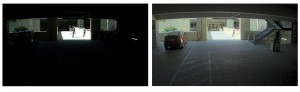 The images above show the difference between a parking garage being monitored by a camera with no WDR or WDR turned off on the left, and on the right the same area monitored by a camera with WDR enabled. The difference is clear as day. Why do they differ so much? The camera with the WDR enabled has two internal Charge-Coupled Devices (CCD). The two devices, or sensors, scan an image at different speeds, one low and one high, the image processor then combines the separate images producing a clearer, more balanced picture with better contrast and lighting. This process happens quickly enough to produce a stream of clear recorded footage. There are many different manufacturers that produce these WDR cameras in the market today, and not all of them use the same type of sensor and image processing combinations. The best way to ensure you are getting the best camera for your specific application is to hire a licensed security systems integrator who is educated in which camera specifications will work best in variant conditions.
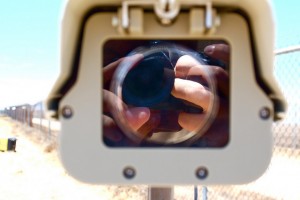 When it comes to security systems you may have heard the term “edge technology,” “edge analytics,” or “edge devices.” What exactly do these terms mean and why are they important? When talking about security systems “the edge” is typically used when referring to video surveillance components. Every security system integrator and industry professional will likely have their own definition of what it means, but in summary “edge technology” refers to surveillance devices that operate, analyze, and record at their source versus transmitting all that information over a network to the system’s core. In traditional surveillance systems there is a central server where recorded data from peripheral devices is stored and analyzed. In an edge-based system cameras perform these functions locally.
 With advancing technology becoming more and more present in our daily lives, it’s no wonder it’s becoming part of our homes too. From solar panels on our roofs to remotely controlled thermostats, we are creating homes akin to the Jetson’s space age abode. Unlike the Jestson’s most of us still live in homes on the ground without robot housekeepers and flying cars.
 You log into your mobile app and swiftly adjust your thermostat to a comfortable temperature. By the time you get home it’s warm and cozy, no need to stay bundled up.